
The Odyssey Review
Epic, enormous and beautiful, Nolan brings his penchant for big screen scale to one of the grandest journeys of legend.
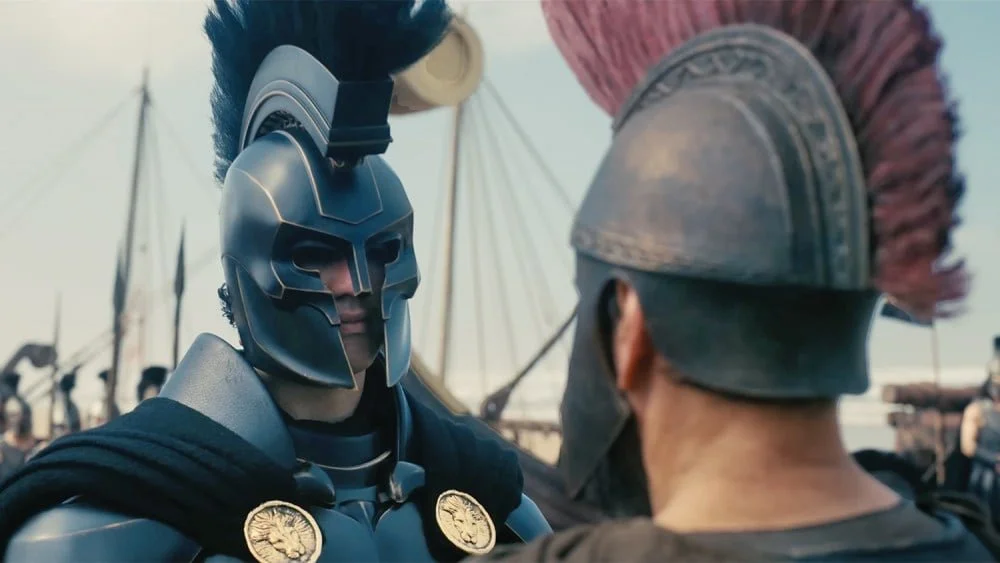
After his act of deceit won the Trojan War, Odysseus (Matt Damon) takes his crew and sails for home. But bad luck, bad omens and perhaps the will of the gods keep him at sea for years and years. At home, his wife Penelope (Anne Hathaway) and son Telemachus (Tom Holland) try to delay a stream of suitors who are seeking to take Odysseus’ place, all while slowly losing hope their King is still alive. Odysseus struggles against the tides that try to keep him away, fighting demi-gods, monsters and men in an attempt to find his way back home.
The Odyssey is the sort of film that needs to be felt in a cinema, on the biggest screen possible. The seats rattling with every clang of the sword into a shield, or music cue. The towering cyclops filling every inch of the screen. The endless expanse of water Odysseus must travel rendered in impeccable detail. And the quiet awe of a cinema fully aware it’s watching a modern master at work.
The film is anchored by a truly impeccable performance from Matt Damon, who brings a level of deep engagement, nuance and emotionality that hasn’t been seen from him in some time. He hits all of the emotional beats to make this a really compelling drama, outside of its scale. He is ably matched by Hathaway, who is fantastic - particularly in a late scene with Tom Holland. Outside of that, Robert Pattinson is a creepy, infuriating standout in a villainous role.
But oftentimes, these performances can feel a little dwarfed by the sheer scale of the visuals. The epic scope of the beach sequences. The gorgeous Greek landscapes and brutalist castle designs. And the visually stunning moment when Agammenon stands in the open gates of Troy. Nolan really elevates some of the sequences out of the ordinary - the remarkable Hades scene feels like a very modern, but deeply affecting take on it - but it is often the on location scale of these real environments that lends such a sense of wonder to the whole thing.
And Nolan breaks the mould too on some of his previous work. His rendering of the iconic meeting with Circe (played to perfection by Samantha Morton) is body horror a la Cronenberg, and the cave with the Cyclops terrifying in its depiction of the beast.
That being said, the classic hallmark of a Nolan critique - the maligned balance between dialogue and SFX - rears its head once again, often obscuring language that can be hard to take in even on a basic level given its blend between modernity and obscurity. But then again, that SFX is something that sticks with you long after you leave the cinema.
If anything otherwise could be said in this film’s opposition, it can only be in the comparison with Nolan’s other work. Films like The Prestige, Interstellar, Inception, and Memento, all hold a part of our cultural psyche nowadays often because of that big ‘A-Ha’ moment. They all had an epic beat that the film built up to, and paid off in one revelatory, ecstatic sense of big screen cinema.
The Odyssey doesn’t have that in quite so clear a way. In many respects, it’s a little closer to Oppenheimer in the way the main character slowly realises the horrors he’s undertaken. But for a film this long and this epic, a clearer epic sense of finality and dialogue might have been welcome.
For all that, the film does end in its last 20 or so minutes by wrapping everything together. It might not do it quite as loudly as his oeuvre, but Nolan nevertheless cuts through the huge, expansive text of Homer to really get to the crux of what he is saying; the meaning of a sacrifice, and the horrifying cost of what Odysseus sacrificed to get back home.
