One of the most remarkable, boundary-pushing, and genre-melding documentaries in memory.
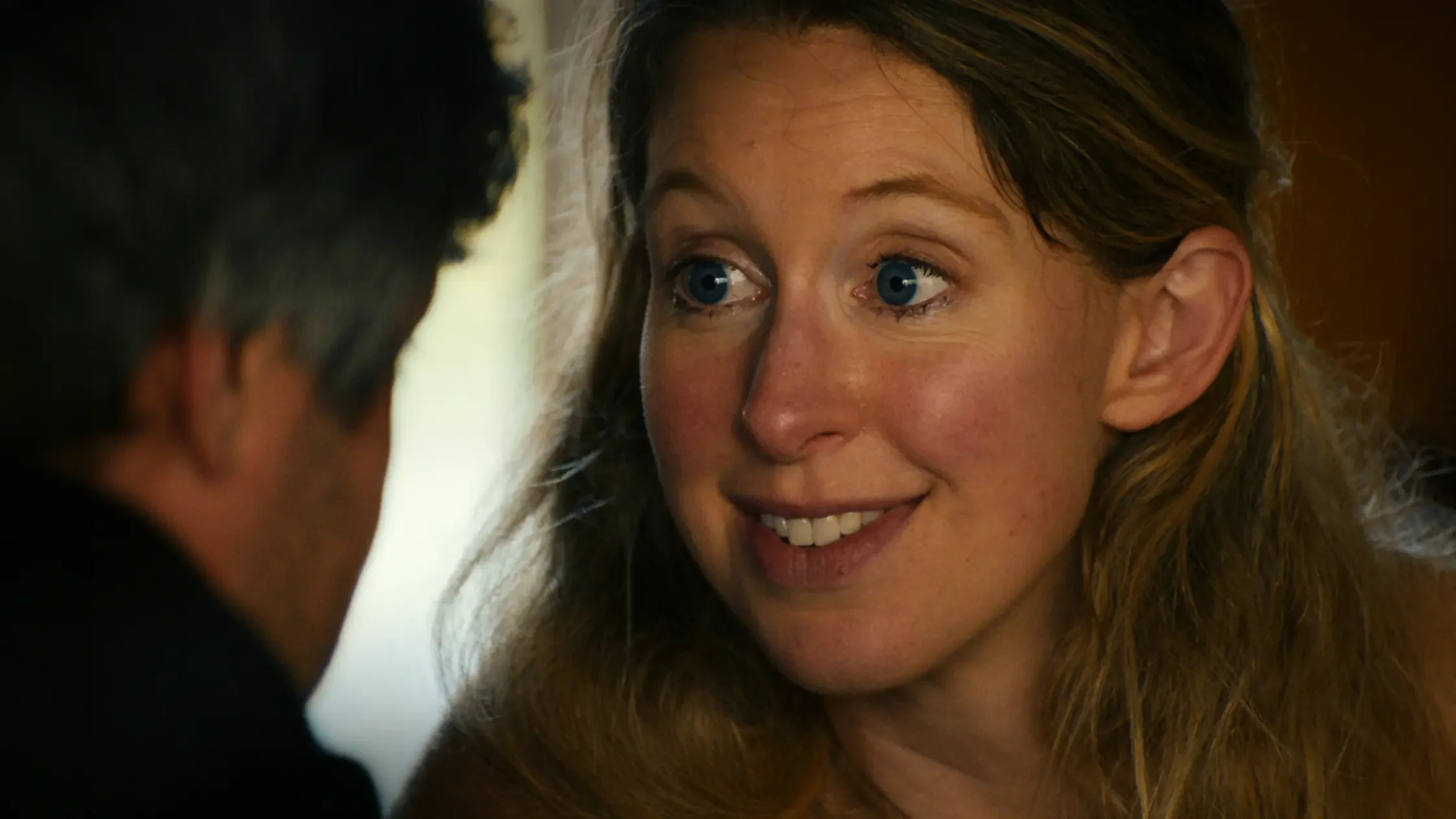
The seismic failure of health-tech startup Theranos in 2015 was probably felt little in Australia, where we often take freely accessible healthcare for granted. It is not only that the scale of financial fraud boggles the mind, but the lost promise of cheap and easy pathology testing in a privatised health system (not to mention potential liability for medical malpractice) which was felt profoundly at the time. The wealth of evidence brought forward in the trial of CEO Elizabeth Holmes would leave little doubt in anyone's mind about her guilt in defrauding investors. Naturally, her next step whilst awaiting her eleven-year federal prison sentence was to invite a renowned comedian into her family home to capture her final days and assert her innocence. What follows is one of the most remarkable, boundary-pushing, and genre-melding documentaries in memory.
One can only imagine what Nathan Fielder must have been thinking when Holmes and her partner Billy Evans gave him and documentarian Lance Oppenheim short-notice, unfiltered access to their personal lives. Fielder’s penchant for elaborate setups to elicit comedic responses from unwitting participants doesn’t scream as first choice to restore the reputation of the publicly demonised Holmes. Indeed, it appears as though Holmes has not even seen his work, but as Evans says, “he sees things differently.”
They enter the house without pretence, intending merely to observe. Fielder’s increasingly strange interactions with Holmes start to shift from documentation to narrative orchestration, all highlighted by uncomfortably close cinematography that lingers on every awkward pause and difficult questions. It is a testament to the pitch-perfect editing that countless hours of non-directed footage are transformed into something so mesmerising we quickly forget this is a documentary at all. Indeed, it is remarkable how merely filming subjects with the framing of a dramatic feature changes how a film can be viewed.
We need not fear a loss of steam in this narrative as Holmes is finally incarcerated; Fielder and Oppenheim carefully construct sympathy for her plight as we watch her devastating reaction to the caricature of her life portrayed in the dramatic TV series The Dropout (with an award-winning turn from Amanda Seyfried as Holmes). That sympathy pushes us into the second act, where the focus smartly switches to Evans’ pursuits to maintain Holmes’ aspirations. His demeanour raises questions about whether Holmes was the mastermind manipulator she was portrayed to be, or was simply the scapegoat of men behaving badly in the dog-eat-dog world of business.
In an effort to better understand Holmes’ mental gymnastics, Fielder seeks out Seyfried to reprise her acclaimed role. Going to his trademark lengths to recreate scenes he couldn’t film, Fielder's attempts to understand others' intentions only serve to prove that we can never really know what others intend. It even raises questions about the ethics of actors portraying real-life characters (particularly controversial ones) their right to profit from it, and the emerging artistic threats of AI.
Although it may seem confusing how we end up here from a simple exploration of the downfall of the once rich and powerful, this masterfully crafted film engages the viewer so emphatically that its near 3 hour runtime seems tantalisingly short. You Can See Everything stands alone among documentaries in its amalgamation of technical prowess and subtle commentary on so many pertinent and challenging topics of the modern media environment.
